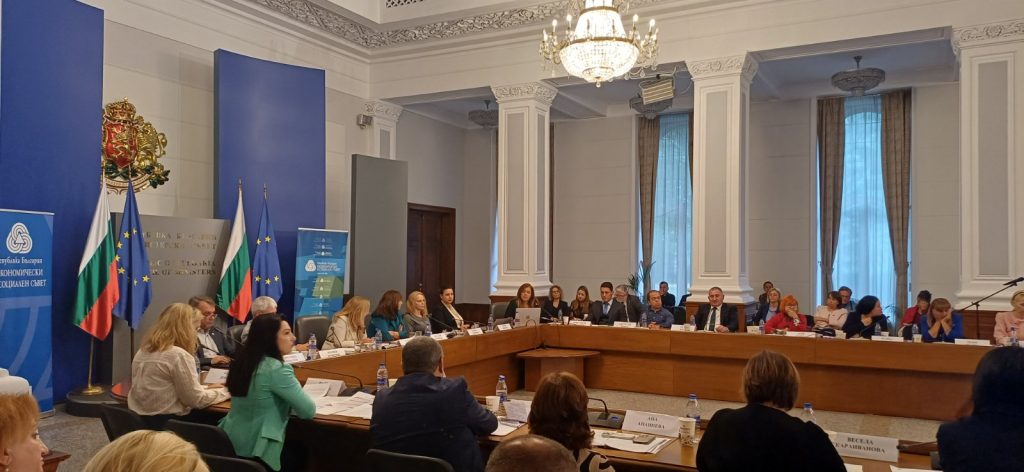
BILSP Presented the main findings of the Ex-post Impact Assessment of the Personal Assistance Act at a Public Consultation in the Council of Ministers
On 29 September 2026, a public consultation entitled “Challenges and Risks in Codifying Social Support Legislation and Its Implications for the Adequacy of Social Payments” was held at the Council of Ministers. The event was organised by the Economic and Social Council in implementation of Council of Ministers Decision No. 466 of 17 June 2026.
Experts from the Balkan Institute for Labour and Social Policy presented the main findings of the ex post impact assessment of the Personal Assistance Act, commissioned by the Ministry of Labour and Social Policy. Covering the period 2019–2025, the assessment draws on an extensive analysis of administrative data, anonymised individual records, surveys and focus groups.
The analysis shows that the Act has secured sustainable access to support for a considerably wider group of people, with the mechanism reaching almost 95,000 users in 2025. However, the expansion in coverage and public expenditure has not been matched by equivalent progress towards independent living, autonomy and social inclusion. In practice, personal assistance functions primarily as a form of support for family care, while opportunities for social, educational and labour-market participation remain limited. The assessment also identified shortcomings in the individual needs assessment, the quality of support, employment arrangements and coordination with other support systems.
BILSP outlined the following key directions for reform:
- improving the individual needs assessment as a common gateway into the support system, with a stronger focus on functional status and the specific needs of different groups;
- clearly distinguishing between sustaining family care and professional support aimed at independent living and social inclusion;
- introducing differentiated legal arrangements for family and professional personal assistants that reflect the actual nature of the care provided;
- adopting quality standards and providing training, supervision, psychological support and replacement care for personal assistants;
- strengthening the links between personal assistance and social services, healthcare, education, employment and rehabilitation;
- monitoring actual outcomes in terms of users’ autonomy and participation, alongside the hours and financial resources provided;
- reducing the administrative burden and introducing mechanisms for greater financial sustainability and more effective oversight.
The consultation brought together representatives of the executive and legislative branches, the European Commission, municipalities, social partners, organisations of persons with disabilities, and experts from national and international institutions. The discussion emphasized that codification should serve not merely to consolidate the existing legislation, but also to build a more coherent, adequate and sustainable support system that improves the access to rights.